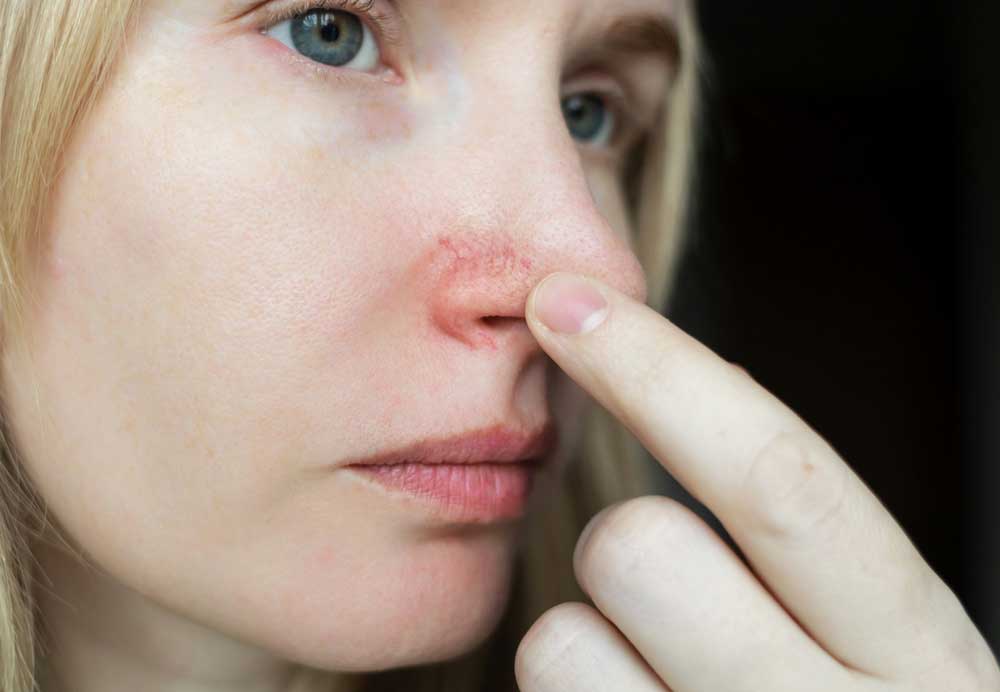
Broken capillaries have a way of showing up uninvited. One week your skin looks even, and the next there is a thin red thread tracing across your cheek or fanning out beside your nose. For people in and around Denver, the mile-high sun does not help, since a thinner atmosphere lets more ultraviolet light reach the skin on an ordinary afternoon.
A pulsed dye laser can fade those vessels while leaving the surrounding skin alone. What surprises most patients is how a beam of light manages to be that selective.
What Broken Capillaries Are and Why They Show Up
Broken capillaries, known in dermatology as telangiectasias, are tiny blood vessels that have widened close to the skin’s surface and stay visible as fine red or purple lines. Despite the name, they are not broken in the sense of leaking. The vessels have dilated and lost the tone that keeps them out of sight.
Plenty of everyday things push them to the surface. Years of sun exposure weaken the vessel walls, which is part of why they appear more often on sun-exposed areas like the cheeks and nose. At Colorado altitude, where the intense summer sun does more damage per hour outside, the vascular kind is something our team sees a lot. Broken capillaries also travel with rosacea, where flushing and visible vessels tend to go hand in hand. Genetics, hormonal shifts, aging and minor trauma all play a role too. On the legs, the same process often results in larger spider veins.
The Science Behind the Precision
The reason a pulsed dye laser can single out a vessel comes down to a principle called selective photothermolysis, first described by dermatologists R. Rox Anderson and John Parrish in the journal Science in 1983. Their research showed that a well-chosen pulse of light can damage a specific target in the skin while sparing everything next to it, with no careful aiming required.
Three things have to line up for that to work:
- The light has to be a color that the target absorbs much more than its neighbors do.
- The pulse has to be short enough that the heat stays put.
- There has to be enough energy to do the job.
Pulsed dye lasers are built around the first of those. The laser is tuned to a wavelength that hemoglobin (the red pigment in blood) soaks up far more readily than the surrounding skin does. Anderson and Parrish demonstrated selective vessel damage at 577 nm, and modern systems operate in a similar range of 585 to 595 nm. When that light hits a broken capillary, the blood inside absorbs it and converts it to heat. The vessel coagulates, and over the following weeks your body quietly clears it away. The skin around the vessel never absorbs enough of that specific light to be affected.
That single-wavelength focus is what separates a pulsed dye laser from broadband tools like intense pulsed light, which spread their energy across vessels and pigment at once rather than homing in on one target.
Why the Surrounding Skin Stays Out of It
Absorbing the right color is only half of the story. The other half is timing.
Every structure in the skin has a thermal relaxation time, which is roughly how long it retains heat before radiating it to its surroundings. Deliver the laser pulse within a window shorter than a tiny vessel’s thermal relaxation time, and the heat builds up inside the vessel and stays there rather than spilling outward into healthy tissue before the pulse ends.
Cooling adds one more layer of protection. At AboutSkin Dermatology and Aesthetics, our devices pair the laser with surface cooling, whether that is a quick cryogen burst milliseconds before each pulse or a stream of chilled air from a Zimmer unit running as low as -22°F. That shielding keeps the pigment-rich top layer of skin comfortable and out of harm’s way while the energy does its work below. For patients with deeper skin tones, our Board-Certified Dermatologists adjust the settings to protect melanin further, since that pigment can compete with hemoglobin for the laser’s attention.
Why Patients Trust AboutSkin for Vascular Laser Work
Precision work rewards experience, and that is where the depth of our team matters. AboutSkin Dermatology and Aesthetics is directed by Dr. Joel L. Cohen, who is a Board-Certified Dermatologist, fellowship-trained in lasers, a Castle Connolly and 5280 Magazine Top Doctor and the author of more than 324 medical articles and book chapters, alongside work on over 100 clinical trials. Our practice also holds a World’s Leading Clinic designation, an independent recognition that cannot be bought.
Dr. Cohen’s involvement with vascular lasers goes beyond clinical use. He has co-authored published work on treating facial telangiectasias with pulsed dye lasers and on using the same technology to speed the fading of a bruise after dermal filler treatment, since trapped hemoglobin in a bruise responds to the laser the same way a broken capillary does.
What to Expect and Who It Helps
Treatment itself is quick. Most people describe each pulse as a brief warm snap, eased by the cooling that runs alongside it. Redness or mild swelling that feels like a light sunburn can follow and usually settles within a few hours to a couple of days, so downtime stays minimal.
A pulsed dye laser treatment suits a range of vascular concerns, including rosacea and facial flushing, broken capillaries, cherry angiomas, certain birthmarks and post-filler bruising. Most focal vessels respond over a short series of sessions rather than after a single treatment, with gradual fading between visits.
Before any laser touches your skin, one of our Board-Certified Dermatologists reviews the cause of your redness, since confirming that the source is vascular is what makes targeting so effective. For patients across the Denver area, that combination of diagnosis and device selection is the difference between a treatment that chases redness and one that resolves it at the source.
Show Those Little Red Lines the Door
A broken capillary does not have to be a permanent houseguest. With the right laser aimed at the right target, redness can fade while the skin around it carries on, none the wiser. Contact AboutSkin Dermatology and Aesthetics to find out what a pulsed dye laser can do for you.